
Sky and international satellite installations and repairs

Fed up of seeing "No satellite signal is being received"?
Have no signal on your Sky+ or Sky Q or international / european satellite system? Programs only part recording or
failing completely? We can give all your equipment a "health check" checking the receiver, dish and dish alignment, LNB and
cabling for less than a standard call out fee charge by Sky - and no doubt much quicker too! And we can then of course advise
on the best course of action to resume your viewing enjoyment without interruption.
Unlike terrestrial TV and radio, where a "local" transmitter situated on a hill or on top of a tall mast broadcasts content
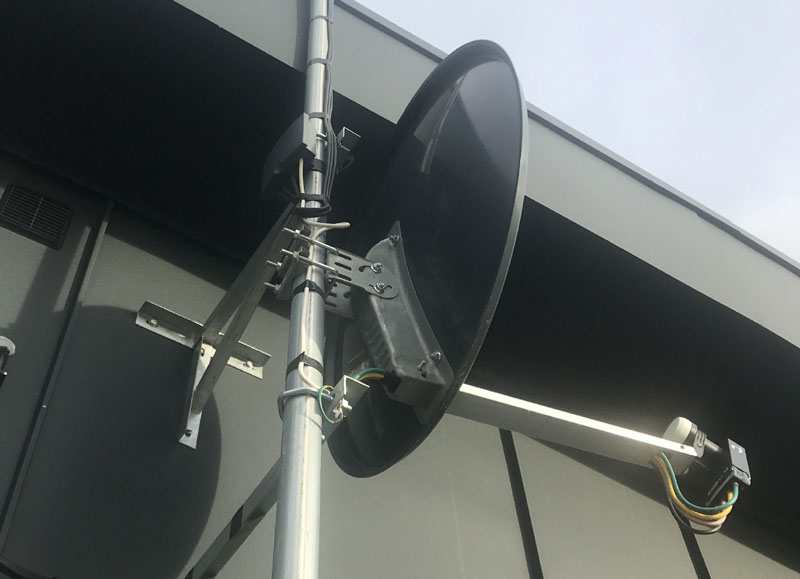
received through a multi pronged element antenna, Satellite TV utilises a relatively simple "dish". A satellite dish is, in its own
right, an antenna with its parabolic shape acting as a reflective lens
focusing the collected signal onto the dish's receiver,
the LNB (low-noise block), which translates and transfers the signal to a satellite receiver box via cabling.
When erecting a terrestrial antenna for reliable reception not only the immediate surroundings but further lying terrain should be
considered but with satellite reception the rules are much more clear cut. If the dish can "see" a tiny spot in the sky for a particular
satellite uninhibited by obstructions such as trees or buildings then reliable reception is relatively easy to achieve.
Any TV satellite that is being received through a dish is itself hurtling through space in the Earth's orbit, but is cleverly and
accurately positioned in that orbit so that it appears to be stationary from Earth. This is achieved by the satellite being
positioned in an orbit west to east directly above and following the Earth's equatorial line at a distance from Earth
of 22,300 miles (35,800Kms). At this distance one orbit of Earth takes exactly 24 hours and as the satellite orbits
in the same direction as the Earth rotates and at the same relative speed as viewed from Earth the satellite appears to be
stationary. This is known as a "geostationary orbit".

The reception of Satellite TV can appear astonishing with signals travelling thousands of miles in just a fraction of a second. From
here in the UK any satellite in a geostationary orbit would be on an arc across the southern horizon with the highest point of the arc
being due south with an approximate inclination of 35 - 45 degrees and roughly 22,500 miles away. With that in mind it's easy to see how
the alignment of a satellite dish is absolutely crucial as being misaligned only a degree or two in any direction, up, down,
left or right and the satellite could be missed by a few hundred miles!
We can check and re-align your dish for you if you are experiencing poor or interrupted reception or advise on receiving satellite content
from other available satellites including motorised dish systems.